Living wall:
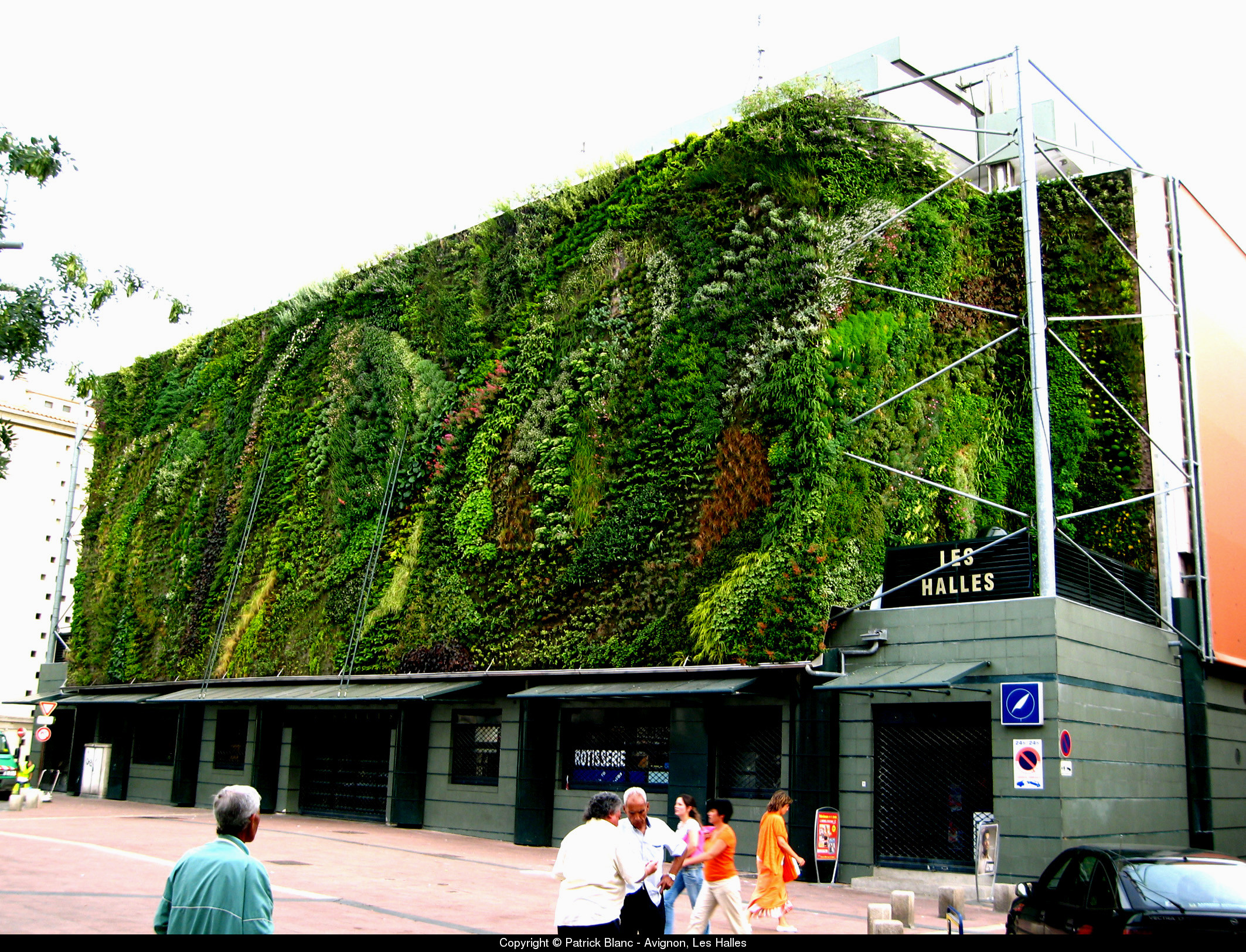
A living wall is a vertical vegetated wall system with irrigation. A living wall system is variable depending on the climatic conditions and there is no proven formula for plant specification, even the most successful walls have evolved from the time of initial installation with the plant palette changing. Interior living walls require supplementary ‘grow’ lights and irrigation with drip trays and drainage outlets. The most lightweight system is hydroponic with two layers of felt matting stapled to poly-board and fixed to a structural wall aka Vertical Gardens / P.Blanc. Slits allow plants to grow in pockets initially until the root system spreads between the two felt layers. The felt is kept constantly damp with nutrient levels specifically maintained. This system was originally developed by Patrick Blanc in 1986 in Paris.
In their more elaborate form, living walls and may incorporate water elements including ponds and ?sh, which provide essential nutrients. Living walls may also be incorporated into the cooling strategy of a house, as a kind of evaporative air conditioner, and they may even be designed as part of a water treatment system.
TYPES OF LIVING WALLS
Living walls, i.e. vegetation growing on or against vertical surfaces, can be found outdoors or indoors on any type of vertical surface, from building façades to boundary demarcation or even free-standing support. They can be incorporated into new construction or easily retrofitted to existing buildings. Living walls can vary considerably in construction; they can be rooted in or off the ground (i.e. soilless), in several kind of growing media (mineral or organic), or in an inert medium acting only as a rooting element. According to the type of structure, the system can be either ‘completely natural’ or hydroponic. Irrigation can be manual or automatic.
Living walls have been divided into three main categories: green façades and green walls; however the concept of the green wall can be extended to a wider range of systems: urban hedges, stone walls, green screens, live curtains and modular planter walls.
Green façades
Green façades are made of climbing plants growing on a wall either with no additional infrastructure, or with the use of stainless steel or wooden trellis, meshwork, or cabling, as plant support. They are historically set outdoors, rooted in the ground and don’t require additional irrigation. They can also be off the ground and erected indoors, usually free-standing with irrigation.
The great diversity of climbing plants, in terms of flower and foliage colours, flowering season, profile, etc. make them attractive for humans. They can be evergreen or deciduous and are usually woody and perennial, although some can be herbaceous or/and annual. As they use different ways of adhering to a surface, they need different kinds of support either vertical and/or horizontal, or no support at all in the case of self-adhering climbers such as Hedera helix(common ivy), Parthenocissus sp. (Boston ivy) or Wisteria sp. (Virginia creeper).
Plants that can be trained against the wall or in espalier (e.g. Camellia sp., Ceanothus sp., Chaenomeles sp. (“flowering quince”), Coronilla valentine (scorpion vetch), Garrya sp., Fuchsia sp., Magnolia grandiflora, Pyracantha sp.) referred to as ‘wall shrubs’ can be included in the term ‘green façade’.
Green Walls
Green walls are recently developed, completely artificial systems, using continuous or modular, planted-up, units. Continuous living wall systems can be made of felt-layers or be a block of concrete. Modular panels are using modules of sphagnum, substrate filled metallic cage, gabions, preformed plastic modules or rockwool units. Plants are rooted directly in the structure (in the case of felt layers or sphagnum units) or in growth medium, beforehand added to the structure (for concrete block, rockwool, plastic preformed module or gabion panel). The growing media can be organic materials such as coconut coir (Cocos nucifera L.), peat, tree bark, or inorganic materials such as expended clay pebbles, gravel, perlite, mineral soil, mineral wool, sand, vermiculite; although different components are often used in mixes. The system is usually hydroponic (i.e. the mineral nutrients are brought to the plant as inorganic ions in water).
Any plant species can be grown on a living wall system. Typically, the only constraint is the weight of the mature plant; some felt layers systems have been shown to support tree species. Indoor walls are usually planted with tropical species due to the constant mild temperature and the lack of light; while outdoor walls are more restricted to rustic plants. Living walls are sometimes referred to as “vertical gardens” when they are used to grow herbs and/or plants producing vegetables or fruits. When growing herbs, the green wall is usually called a “herb wall”.
Depending on the system and the manufacturer, units are either pre-grown in greenhouse (vertically or not) prior to installation or planted on site once installed.
Intermediate living walls
Green Façades and Green Walls are the opposites, in terms of complexity of structure and man-made features, of the large panel of the green wall concept. Between these two can be found features like Green screens, made of a climbing plant (typically Hedera sp.), pre-grown on a freestanding, galvanized steel framework, and established as an instant hedge. They are usually included in the concept of green façades. However, the facts that they are commercially pre-grown in nursery, completely free-standing when historically green façades are against walls, and usually installed with automatic irrigation, may set them apart from green façades.
Live curtains combine the features of green façades and living walls. Like green façades, this system is made of plants climbing on a structure, but rooted off the ground, in small planter boxes, as hydroponic systems like living walls.
Urban hedges can be considered as part of the green wall concept as they are interchangeable with green façades or living walls for some of their features and ecosystem services.
Stone walls are horizontal structures of overlapping stones build upwards, with successive rows of stones overlapping each other. The space between two rows is filled with smaller stones and sometimes with capping stones bridging the top. A distinction is made between dry stone walls and mortared walls that are usually more shaped with regularly rectangular stones held together by mortar. While dry stone walls are usually only freestanding demarcation walls, mortared walls can be used as boundary walls and retaining walls. Stone walls can be colonized by vegetation, usually following a natural process rather than being deliberately man-made.
Appearance
Indoor greening can be either an extension of the green wall concept or can include the creation of indoor planters as integral parts of the house. Green walls make it possible to have lots of greenery without using too much ?oor space. Imagine walking into a room with plants covering one or morof the wall surfaces – living greenery on vertical surfaces can create quite striking impacts.
Green wall systems range from arrangements of planting pots on layers of custom shelving to sophisticated vertical layers of growing medium, geotextiles and purpose made containers. Depending on the size of the wall, large or small plants can be used and the result can be manicured and elegant (think of a privet hedge) or wild and funky.
Green walls can humidify and oxygenate the air and, depending on the plant species, can further improve indoor air quality by acting as ?lters, trapping dust and absorbing pollutants like formaldehyde.
Thermal mass
There is little thermal mass in the vegetative component of green roofs and although there may be some mass in the soil, the usual growing medium is lightweight and is consequently more useful as insulation rather than thermal mass. Green walls have a relatively low thermal mass for the same reason. The supporting structure for extensive roofs (and green walls) is also usually lightweight, with little thermal mass, whereas the structures required for intensive roofs almost invariably employ concrete slabs or similar structures with an inherently high thermal mass.
Insulation
Green walls can be retro?tted to existing homes to reduce the heat load on façades. The simplest kind is a trellis set with a gap between it and its supporting wall to create shade from vegetation with passive cooling from transpiration of the vegetation and convection of heat up through the gap.
In warmer weather, green walls act like green roofs by reducing the surface temperature of a conventional wall through evapotranspiration and shading. Walls that use irrigation and hydroponic techniques provide additional cooling through evaporation.
Shading windows by deciduous vegetation (bioshading) reduces cooling demands by limiting solar gain in the summer whilst allowing daylight in during winter. The insulating and low thermal absorption properties of green roofs also reduces the urban heat island effect.
Sound insulation
In busy urban settings the acoustically absorbent nature of soil and vegetation of green walls can insulate against the noise of heavy vehicles like trains, trams, buses and trucks. One of?ce building under the ?ight path of San Francisco’s International Airport, planted with a mixture of indigenous grasses and wild?owers, has been designed to achieve noise transmission reductions of up to 50 decibels.
An extensive thin green wall just 100mm deep will reduce noise transmission by at least five decibels.
Breathability and toxicity
Vegetation in urban areas can ?lter out ?ne airborne particles which then wash off into the soil and foliage can absorb gaseous pollutants so it can be reasonably assumed that green walls provide the same services. Studies have shown that extensive combined green walls & green roofs can trap up to 95 per cent of heavy metals in the local atmosphere.
Sustainability (environmental impacts)
Green walls contribute towards a wide range of sustainable development objectives, including:
Stormwater management.
Climate change mitigation and adaptation.
Conservation and enhancement of biodiversity.
Retention and binding of contaminants (bird droppings or atmospheric pollution) can assist removal of harmful pollution from run-off into
aquatic ecosystems.
The heat island effect is reduced by green roofs. Researchers at the Welsh School of Architecture recently concluded that green roofs and walls can cool the local climate around a building in a city by between 3.6°C and 11.3°C and the hotter the climate, the greater the cooling effect.
Habitat can be created to increase biodiversity and attract wildlife including rare or migratory birds. Encouraging birds, butter?ies and bees has been a significant aspect of Asian suburban green walls.