AIPH World Green City Awards 2024 at the Future Green City World Congress!

AIPH World Green City Awards 2024 at the Future Green City World Congress!

AIPH is proud to announce that the prestigious gala dinner and awards ceremony for the AIPH World Green City Awards 2024 will take place in the City of Utrecht at the Future Green City World Congress in September 2024. 

The prestigious Awards ceremony will take the form of a dedicated gala dinner, set to be hosted on 25 September 2024 at the Royal Jaarbeurs in the heart of the City of Utrecht, Netherlands. The momentous occasion forms an integrated part of the official program of the first Future Green City World Congress, which is a global four-day event organised by the Royal Association Stadswerk the Netherlands, the Royal Dutch Society for Garden Designers and Landscapers (VHG), and the City of Utrecht. 

The Future Green City World Congress will be held from 23– 26 September 2024 at the Beatrix Theatre in Utrecht., with over 3000 experts from around the world expected to attend and share their passion and knowledge for shaping greener cities of the future.

Connecting all professionals and decision makers in the urban greening sector, the Congress boasts an exciting programme which will showcase the most inspiring examples of green city transformations from all over the world, making it the perfect global stage on which to celebrate the Finalists and winners of the AIPH World Green City Awards 2024.

The time is now, like never before, to come together in unity to shape the greener, healthier, and more resilient cities of the future. Registration for the Congress and the Awards ceremony gala dinner will open soon! Contributions to the program are invited with proposal submissions accepted here.

Find more information about the AIPH World Green City Awards 2024. 

Future Green City World Congress: https://fgc2024.com/ 
Follow us on our social channels.

Follow us on the channel that best suits you to receive our latest updates!

NEW

LATEST POSTS

Green roofs for urban rainwater and stormwater management

The new paper by WGIN’s EU Chapter “Green Roofs for Urban Rainwater and Stormwater Management”, explores how green roofs can contribute to more climate-resilient cities. The paper highlights their role in managing rainfall, reducing pressure on urban drainage systems, and delivering wider benefits for biodiversity, urban cooling and well-being. Published ahead of the European Commission’s forthcoming Climate Resilience Framework, the paper underscores the importance of integrating green infrastructure and nature-based solutions into urban planning and climate adaptation strategies. Download the paper here.

Green roof research measures performance, but not yet people

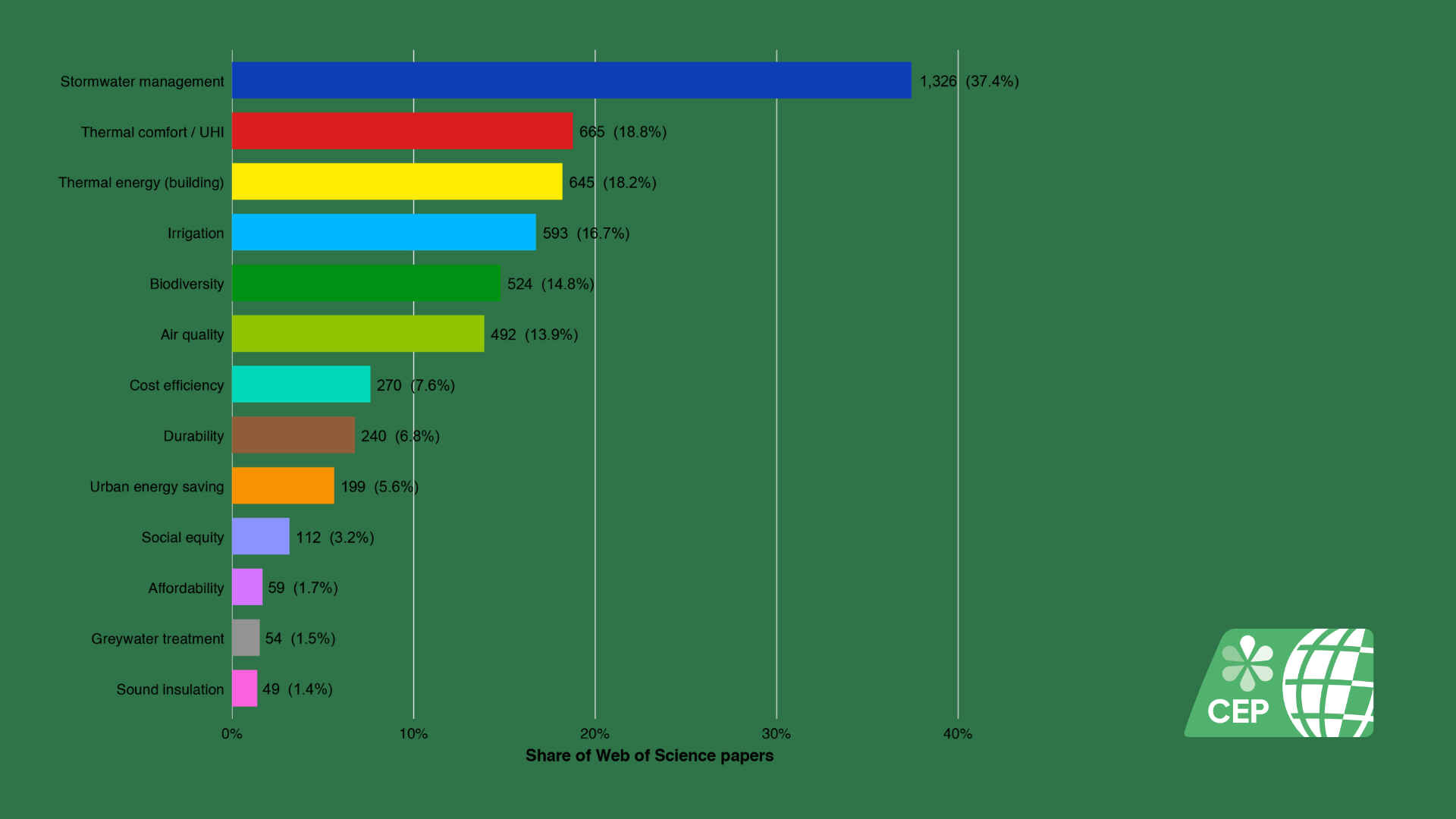
New study maps 25 years of green roof literature and finds affordability and social equity nearly invisible. Submitted by WGIN members Ferre Maes and Bert Belmans In a study published in City and Environment Interactions, WGIN members Ferre Maes and Bert Belmans, together with Roméo Delcroix (Vrije Universiteit Brussel), analysed more than 3,500 green roof articles published between 2000 and 2025. They tracked how often 13 performance dimensions appear in titles, abstracts and keywords. The results show a clear imbalance. Stormwater management appears in 37% of publications, urban heat island mitigation in 19% and building energy in 18%. Affordability (1.7%) and social equity (3.2%) are among the least visible topics in the field, and have remained marginal for 25 years. The study does not show that green roof implementation is inequitable; it shows that the published evidence cannot yet answer this question. Research on parks, urban greening and green stormwater infrastructure engages with affordability and equity far more often, which shows this gap can be closed. There is no reason green roof research can’t do the same. A call to action WGIN’s mission is to advocate and promote the integration of green infrastructure in urban planning, globally. But planning decides who benefits, and evidence on who benefits is largely missing. If we want cities, funders and residents to trust green roofs as a public good, we need to be open about what we know and what we don’t. That openness is also an opportunity: evidence on affordability and equity is what opens the door to public funding, social housing and neighbourhoods green roofs have yet to reach. We call on our community to: Count people, not just performance. In research papers, project reports and case studies alike, report cost, access and who benefits alongside technical results. In publications, name affordability and equity explicitly in titles and abstracts so the work can be found. Plan for equity from the start. Build these questions into green roof strategies, subsidies, projects and research calls, before roofs are built. Make costs transparent. Manufacturers, installers and researchers alike can share life-cycle cost data, from installation and maintenance to lifespan and savings, in a consistent and anonymised format, so support schemes can reach beyond those who can already afford a green roof. Neighbouring fields already study performance and people together. The green roof community can too! Read the full paper here: 10.1016/j.cacint.2026.100476 (open access)

WGIN Global Green Roof Professional Development and Accreditation Programme – Call for National Associations Partners

In April 2026, WGIN launched the Global Green Roof Professional Development and Accreditation Programme. This initiative aims to establish an internationally recognised professional training programme focused on green roof design, installation practices, maintenance, and long-term performance. The online training is designed to deliver a set of universal quality best practices rooted in knowledge rather than technical skills. The programme’s intent is to accelerate the development of national and regional green roof markets by providing online training and accreditation.  The Global Green Roof Professional Development and Accreditation Programme is now looking for two national associations to design national training modules and examination questions based on the core curriculum developed under this project. The application process is open until 7 September. Selected national associations will be contacted by 21 September. For more information, see the call for interest. To apply for the call of interest, visit this link.