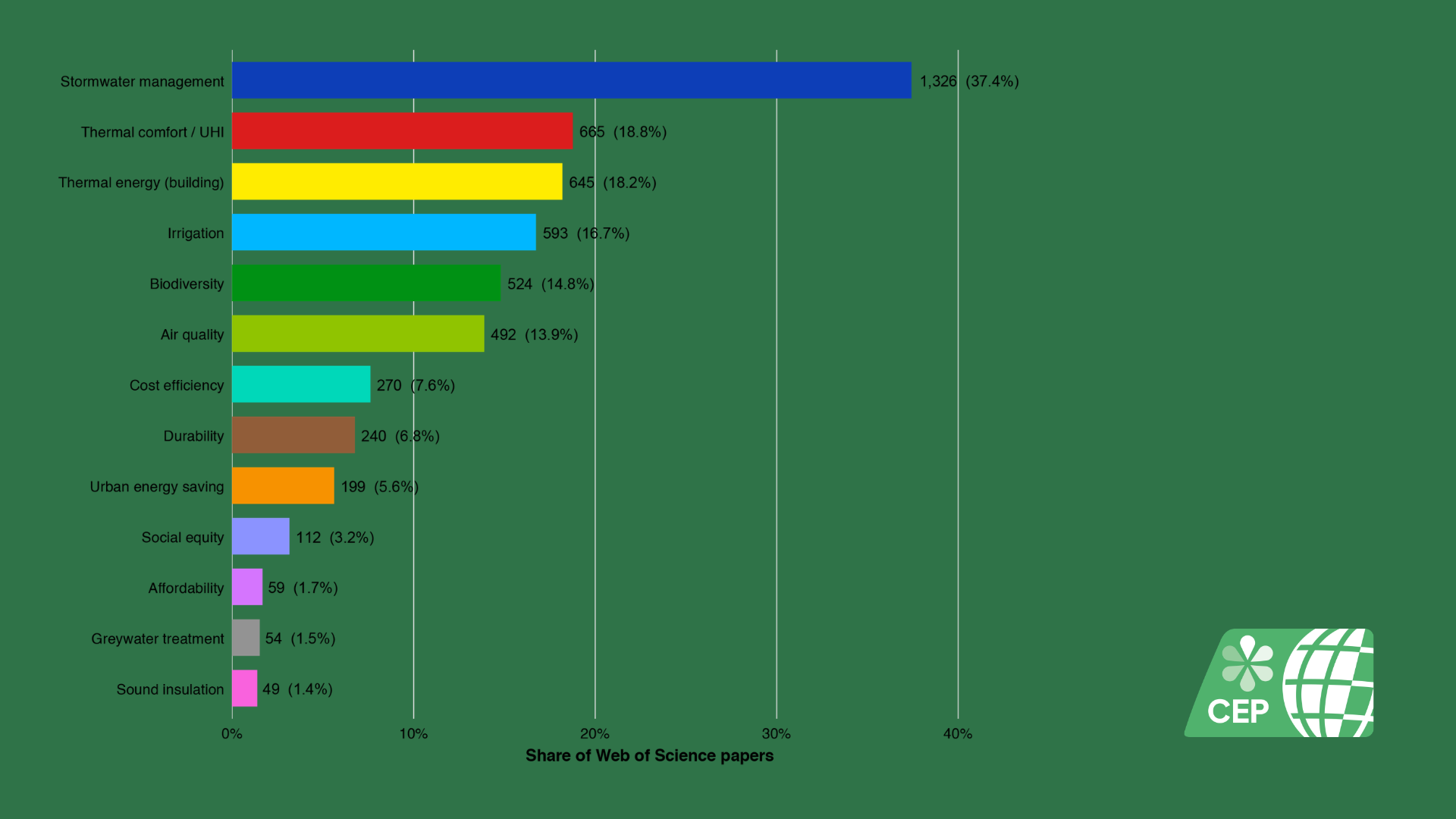
New study maps 25 years of green roof literature and finds affordability and social equity nearly invisible. Submitted by WGIN members Ferre Maes and Bert Belmans In a study published in City and Environment Interactions, WGIN members Ferre Maes and Bert Belmans, together with Roméo Delcroix (Vrije Universiteit Brussel), analysed more than 3,500 green roof articles published between 2000 and 2025. They tracked how often 13 performance dimensions appear in titles, abstracts and keywords. The results show a clear imbalance. Stormwater management appears in 37% of publications, urban heat island mitigation in 19% and building energy in 18%. Affordability (1.7%) and social equity (3.2%) are among the least visible topics in the field, and have remained marginal for 25 years. The study does not show that green roof implementation is inequitable; it shows that the published evidence cannot yet answer this question. Research on parks, urban greening and green stormwater infrastructure engages with affordability and equity far more often, which shows this gap can be closed. There is no reason green roof research can’t do the same. A call to action WGIN’s mission is to advocate and promote the integration of green infrastructure in urban planning, globally. But planning decides who benefits, and evidence on who benefits is largely missing. If we want cities, funders and residents to trust green roofs as a public good, we need to be open about what we know and what we don’t. That openness is also an opportunity: evidence on affordability and equity is what opens the door to public funding, social housing and neighbourhoods green roofs have yet to reach. We call on our community to: Count people, not just performance. In research papers, project reports and case studies alike, report cost, access and who benefits alongside technical results. In publications, name affordability and equity explicitly in titles and abstracts so the work can be found. Plan for equity from the start. Build these questions into green roof strategies, subsidies, projects and research calls, before roofs are built. Make costs transparent. Manufacturers, installers and researchers alike can share life-cycle cost data, from installation and maintenance to lifespan and savings, in a consistent and anonymised format, so support schemes can reach beyond those who can already afford a green roof. Neighbouring fields already study performance and people together. The green roof community can too! Read the full paper here: 10.1016/j.cacint.2026.100476 (open access)