
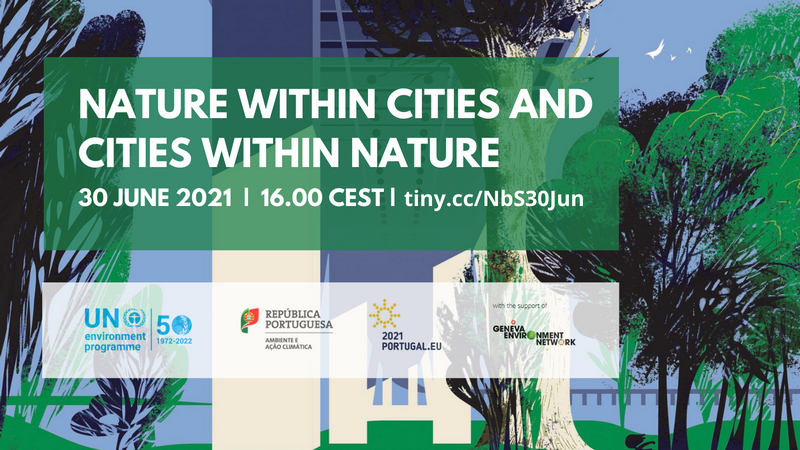
Nature within cities and cities within nature

Nature within cities and cities within nature

30 JUNE 2021

BACKGROUND

You are cordially invited to a high-level event, co-organized by the United Nations Environment Programme and the Portuguese EU Presidency, aiming at demonstrate the value of Nature-based Solutions (NbS) for cities, from developing climate resilient pathways to harnessing a broad range of environmental and socio-economic benefits. The event will highlight local participatory approaches as bases for long-term success, look at ways to scale impact with innovative approaches and call for genuine action across differentscales and sectors.

The event will focus on exploring the multiple benefits of NbS for cities, highlighting opportunities and challenges to advance and scale up NbS, from local action to global solutions, accelerating impact in 2021 and beyond. The event starts with a high-level panel (16:00 – 16:30 CEST) which will discuss how the application of NbS can provide long-term social, ecological and economic benefits. The second session (16:30 – 17:30 CEST) features two technical panels with a focus on implementation challenges and opportunities as well as models for scaling up NbS from local action to global solutions.

AGENDA

Opening Remarks H.E. João Pedro MATOS FERNANDES, Portuguese Minister for the Environment Inger ANDERSEN, Executive Director, UNEP Multiple Benefits of NbS H.E. Ana ABRUNHOSA, Portuguese Minister of Territorial Cohesion H.E. Svenja SCHLUZE, German Federal Minister for the Environment, Nature Conservation and Nuclear Safety (Video) H.E. Andrej VIZJAK, Slovenian Minister of the Environment and Spatial Planning (Video) Opportunities and Challenges to Advance NbS Philippe TULKENS, acting Head of Unit, DG Research & Innovation, Healthy Planet Directorate, European Commission Ana DAAM, Head of Division of Sustainable Finance and Adaptation, Portuguese Environment Agency Rosário OLIVEIRA, Researcher, Institute of Social Sciences (ICS), University of Lisbon From Local Action to Global Solutions: Models for Scaling up NbS Duarte D´ARAÚJO, Landscape Architect, Lisbon Municipality Angela CRUZ GUIRAO, Director of Green and Sustainable Development, Campinas City Hall Q&A session Wrap up by Moderators Susana NETO (University of Lisbon) and Catarina ROSETA-PALMA (ISCTE-IUL)
Follow us on our social channels.

Follow us on the channel that best suits you to receive our latest updates!

NEW

LATEST POSTS

In Memoriam: Professor Nigel Dunnett (1963–2026) – A Champion for Biodiversity in Living Cities

The global green infrastructure community is saddened by the loss of Professor Nigel Dunnett, who passed away on April 26, 2026, at the age of 63. As a visionary horticulturalist, author, and Professor of Planting Design and Urban Horticulture at the University of Sheffield, Nigel was one of the world’s most influential voices in redefining the relationship between nature, architecture, and urban planning. At the World Green Infrastructure Network (WGIN), we honor his extraordinary legacy. Nigel did not just design gardens; he pioneered a philosophy that transformed urban spaces into dynamic, climate-resilient, and living ecosystems. Nigel was actively involved with the World Green Infrastructure Network (WGIN) as the UK representative in WGIN. Nigel participated in several congresses of the network, among others in Toronto in 2009, Mexico in 2010 and in Nantes, France in 2013. He advanced the field of knowlegde and practice in urban biodiversity through his guidance of several PhD candidates and the legendary internationally inclusive conferences in Sheffield. A Leading Voice for the Green Infrastructure Community of Practice Nigel Dunnett was central to the transformation of the green infrastructure movement, shifting the global professional focus from sterile, hard landscapes to biodiverse, high-performing “soft” infrastructure. He bridges the gap between rigorous ecological science and breathtaking artistic design, proving that urban greening could be simultaneously wild, functional, and deeply beautiful.His contributions to our community of practice are monumental: A Pioneer of Naturalistic Planting: Alongside his long-time collaborator James Hitchmough, Nigel pioneered ecological, seed-based naturalistic planting. He challenged traditional, high-maintenance landscape management by proving that diverse, low-input plant communities could thrive in harsh urban environments. Transforming Public Consciousness: His high-profile masterworks brought the concepts of urban biodiversity and green infrastructure into the global spotlight. From the spectacular, climate-adapted expanses of the Queen Elizabeth Olympic Park to the Tower of London “Superbloom” and the Barbican Beech Gardens, Nigel showed the world what a green city could truly look like. Sustainable Urban Drainage (SuDS): Nigel was a fierce advocate for integrating water management into the urban fabric. His work on the Sheffield “Grey to Green” project remains a gold-standard blueprint for how cities can use bioswales and urban vegetation to mitigate flooding while enhancing public life. Author: Nigel authored Planting Green Roofs and Living Walls (co-authored with Noël Kingsbury) Dunnett and Kingsbury shifted the narrative on building integrated green infrastructure by arguing that green roofs and living walls should be designed as dynamic, highly biodiverse, and aesthetically pleasing ecological systems. Together with Andy Clayden Nigel co-authored Rain Gardens: Managing Water sustainably in the Garden and Designed Landscape. Following the same philosophical line as his work on green roofs, Nigel revolutionized how landscape architects and garden designers approach urban hydrology. Educator and Innovator: Beyond his books and research papers, he founded the social enterprise Pictorial Meadows, democratizing ecological urban design by making wildflower meadow systems accessible to municipalities worldwide. As an educator, he inspired multiple generations of landscape architects to prioritize ecological integrity. Healing Through Nature: The Aberdeen Royal Infirmary Roof Garden While Nigel’s grand urban masterplans won international acclaim, my personal favorite of Nigel’s many contributions to our field is the role he played in the creation of The Robertson Family Roof Garden at the Aberdeen Royal Infirmary. The project originated from Nigel’s gold medal-winning RBC Blue Water Roof Garden at the 2013 RHS Chelsea Flower Show. Rather than letting the installation disapear after the show, Nigel collaborated with the hospital’s Chaplin James Bell Falconer to adapt the design and installation into a permanent, 24/7 therapeutic sanctuary in the heart of the hospital. Opened officially by Queen Elizabeth II in 2017, the garden represents a pinnacle of biophilic, inclusive healthcare design. Nigel engineered the rooftop to be entirely accessible, ensuring that even critically ill, fully ventilated patients from the intensive care unit could be wheeled outside to experience the open air, the rustle of grasses, and the scent of trees. The Aberdeen roof garden stands as a powerful testament to Nigel’s belief that access to nature is not a luxury, but a fundamental human right—and an essential component of clinical recovery and psychological restoration. A Lasting Legacy Nigel Dunnett’s work altered the trajectory of modern landscape architecture. He taught us that urban nature should not be merely decorative, but an active, spontaneous, and healing force woven deeply into our buildings and streets. The World Green Infrastructure Network extends our deepest condolences to his wife Marta, sons Alex and Jack, colleagues, and the countless students and professionals he inspired.

European Green Infrastructure Day 2026

European Green Infrastructure Day is back!  And this year, it will be a full-day event. Join us on 29 September in Brussels for the fifth edition of our annual gathering to discuss urban green infrastructures. This year’s edition will place a strong focus on the European Climate Resilience Framework, highlighting the key role that green spaces play in strengthening Europe’s resilience to climate change and building sustainable, future-proof communities. Bringing together EU policymakers, experts, local authorities, practitioners and NGOs, EGI Day 2026 will explore how greener cities can contribute to climate adaptation, improve water resilience and enhance the quality of life in urban areas across Europe. Join us for a full day of discussion, knowledge-sharing, and collaboration on the future of urban resilience. Speaker announcements and registration details coming soon!

Choosing green and blue over grey to improve cities’ climate resilience

Climate change is making extreme weather events more frequent and severe, increasing the vulnerability of Europe’s cities . Heatwaves, flooding, droughts and water scarcity are already affecting citizens, infrastructure, and economic activity, and continued urbanisation further intensifies these challenges. As the European Chapter of the World Green Infrastructure Network (WGIN), we publish today a new position paper ahead of the upcoming publication of the European Climate Resilience Framework, planned for release during Q4 2026. We call the Commission to ensure that the t Climate Resilience Framework: Embed a mandatory “resilience-by-design” principle across EU planning, public spending, and sectoral policies. Establish a clear EU definition of a climate-resilient city, adaptable to national and regional contexts. Require climate risk assessments for urban areas, including pathways to scale up blue-green infrastructure solutions. Prioritise urban areas, buildings, and critical infrastructure, ensuring renovation policies deliver future-proof, climate-resilient buildings. Strengthening climate resilience in Europe must start with cities and the built environment. Read our full set of recommendations here.