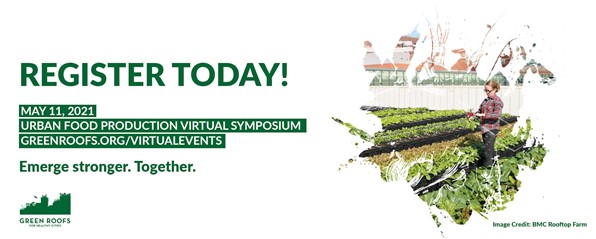
11 MAY: GRHC’s Urban Food Production Virtual Symposium!

11 MAY: GRHC’s Urban Food Production Virtual Symposium!

A year into the COVID-19 pandemic, we have all been affected tremendously. With this, people are beginning to look for innovative solutions that will allow them to bounce back.

Urban agriculture has grown rapidly in popularity and is quickly being understood as a resilient solution to COVID19. Urban agriculture helps support strong local economies and brings communities back together again, two things that are vital in COVID19 recovery. Not only will urban agriculture be an effective solution with COVID19, but it also provides many other benefits.

          When you think of urban agriculture you probably think about urban space for food production, especially for fruits and vegetables. But, there are other viable types of production that you can get involved in, including microgreens, mushrooms, and edible insects! As well, urban agriculture has more capabilities than food production! It supports local economies, creates jobs, improves food access, and provides ecosystem services.

On May 11th, Green Roofs for Healthy Cities is hosting the Urban Food Production Virtual Symposium. The agenda will provide managers, researchers, and urban planners with an understanding of this burgeoning industry and tools to adopt these practices. GRHC brings together early adopters and pioneers so we can understand their successes and losses.

Approved for 3.75 APLD CEUs, 3.75 ASLA CEUs, 4 GRP CEUs and 3 AIA CEUs.

Admission: $50 USD

To learn more and register for the event: https://greenroofs.org/virtualevents/2021/5/11/urban-food-production-virtual-symposium
Follow us on our social channels.

Follow us on the channel that best suits you to receive our latest updates!

NEW

LATEST POSTS

European Green Infrastructure Day 2026

European Green Infrastructure Day is back!  And this year, it will be a full-day event. Join us on 29 September in Brussels for the fifth edition of our annual gathering to discuss urban green infrastructures. This year’s edition will place a strong focus on the European Climate Resilience Framework, highlighting the key role that green spaces play in strengthening Europe’s resilience to climate change and building sustainable, future-proof communities. Bringing together EU policymakers, experts, local authorities, practitioners and NGOs, EGI Day 2026 will explore how greener cities can contribute to climate adaptation, improve water resilience and enhance the quality of life in urban areas across Europe. Join us for a full day of discussion, knowledge-sharing, and collaboration on the future of urban resilience. Speaker announcements and registration details coming soon!

Choosing green and blue over grey to improve cities’ climate resilience

Climate change is making extreme weather events more frequent and severe, increasing the vulnerability of Europe’s cities . Heatwaves, flooding, droughts and water scarcity are already affecting citizens, infrastructure, and economic activity, and continued urbanisation further intensifies these challenges. As the European Chapter of the World Green Infrastructure Network (WGIN), we publish today a new position paper ahead of the upcoming publication of the European Climate Resilience Framework, planned for release during Q4 2026. We call the Commission to ensure that the t Climate Resilience Framework: Embed a mandatory “resilience-by-design” principle across EU planning, public spending, and sectoral policies. Establish a clear EU definition of a climate-resilient city, adaptable to national and regional contexts. Require climate risk assessments for urban areas, including pathways to scale up blue-green infrastructure solutions. Prioritise urban areas, buildings, and critical infrastructure, ensuring renovation policies deliver future-proof, climate-resilient buildings. Strengthening climate resilience in Europe must start with cities and the built environment. Read our full set of recommendations here.

Policy Guidance: Making European Cities healthier, more resilient and beautiful

  WGIN’s European Chapter and EFB have released a new set of implementation guidelines to support the national adoption of European legislation. The document provides practical guidance on how to implement legal provisions that can accelerate the deployment of green roofs and green walls, generating multiple benefits for people, cities, and the environment, including climate resilience, increased biodiversity and enhanced urban wellbeing. They offer direction on implementing key EU legislative instruments: Energy Performance of Buildings Directive (EPBD) Energy Efficiency Directive (EED) Urban Waste Water Treatment Directive (UWWTD) Nature Restoration Regulation (NRR) With scientific evidence and a set of practical steps, the document shows how effective implementation of green roofs and walls can support meeting EU obligations and climate goals. Download the full paper here.