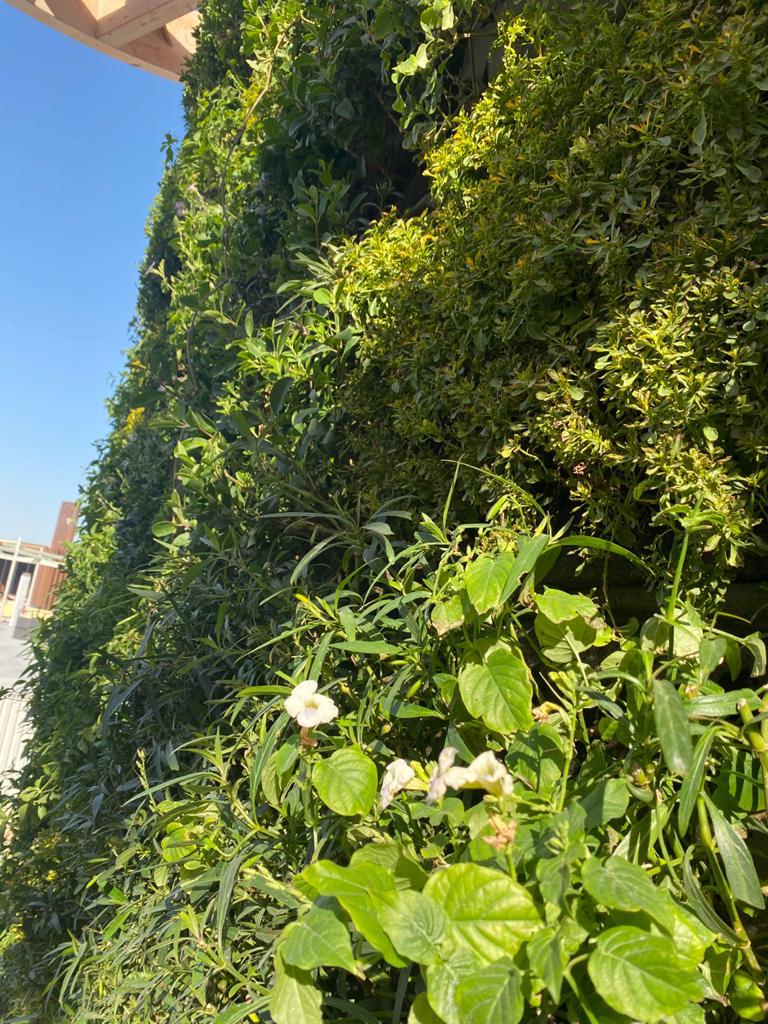
Slovenian Pavillon at Expo 2021 in Dubai

Slovenian Pavillon at Expo 2021 in Dubai

With a total surface of 460 m2 it is by far among the biggest projects in the MEA region.

We are very proud to be a part of the Slovenian pavilion at EXPO 2021 in Dubai, which showcases Slovenia as the green heart of Europe, situated at an important European crossroads combining natural elements: water, forest and wood. It features an eye-catching 6 meters high Urbanscape® Green wall with 45,000 plants. The wall is designed in 11 varieties of locally grown plants in green shades to represent Slovenian forests. The Slovenian Pavilion and its Urbanscape® Green wall is unique for its lush green impact in a desert environment like Dubai, UAE. With a total surface of 460 m2 it is by far among the biggest projects in the MEA region. The Green Wall covers an area of 460 m2, with about 1500 installed green wall panels (30 are custom made) and 45.000 hand-planted local plants selected by the client. The load-bearing structure of green wall panels is represented by more than 1000 meters of various profiles.

A lush green impact in a desert environment like Dubai
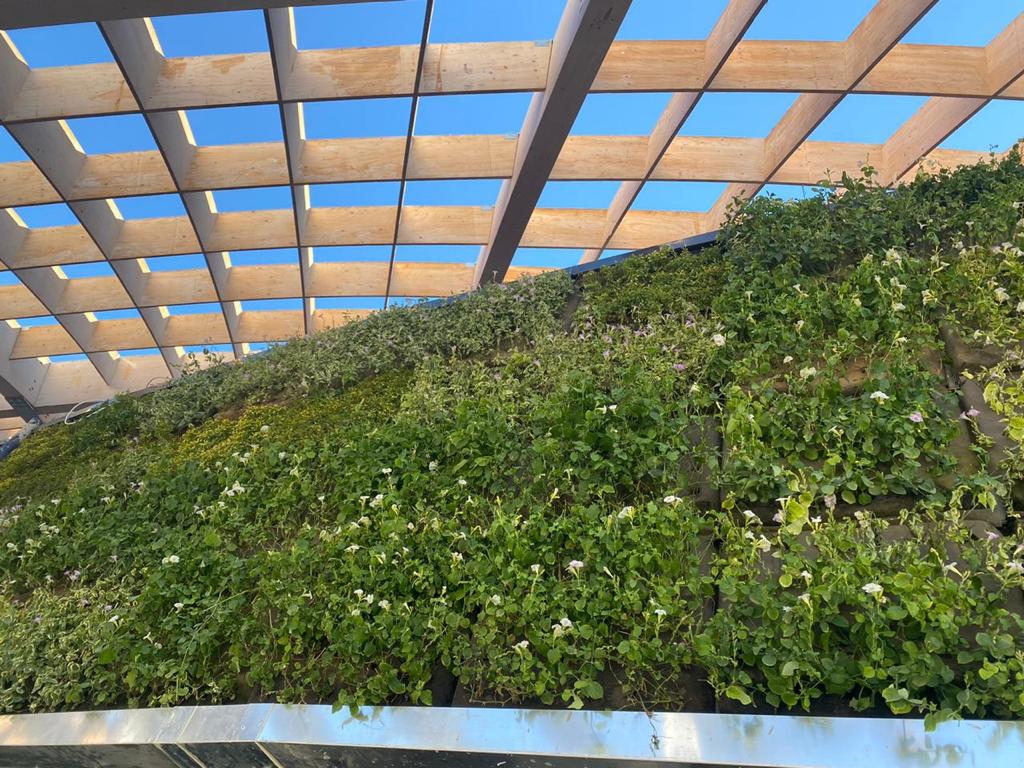
The project started in the spring of 2020 and it was definitely specific from several perspectives. It required combining different approaches and a lot of coordination. We had been challenged to find a solution that would represent Slovenia and would at the same time fit in the local environment and climate.
Around the building there was a pool area representing Slovenian lakes as our natural treasure. This meant our solution had to be hydroponic based and not soil based to avoid small soil particles leaching in the pool area which could stain the water.

The installation of the profiles took place in extreme conditions, at extremely high outdoor temperatures. During the installation, the planted plants were already thriving quite nicely which was also noticed by swarms of grasshoppers. Luckily for us, they fed only on one plant species which meant we had to replant “only” a few thousand plants.

The Green Wall covers an area of approximately 500 m2, with about 1,500 installed green wall panels (30 are custom-made) and 45,000 hand-planted local plants selected by the client. The load-bearing structure of the green wall panels is represented by more than 1,000 meters of various profiles. It weights up to 45 kg/m2 when fully saturated with water. 

The Urbanscape® Green wall at Expo 2020 is hydroponic based. The growing media used in the green wall is rock mineral, as a light and inert substrate, where nutrient dosing is easier to regulate and the environment is more controlled than in conventional soil substrate mixtures; it is a pH-neutral substrate (7). The rock mineral growing media has an enormous water retention capacity (up to 90% of volume) and is therefore even more suitable for growing plants in arid climate.We are using the most advanced irrigation systems for watering the green walls. The average water consumption on this project will range from less than 2 liters/m2 in winter, and up to 4 liters/m2 in summer (with temperatures exceeding 40°C).

Designer: Urbanscape
Year: 2021
City: Dubai
owner website

Follow us on our social channels.

Follow us on the channel that best suits you to receive our latest updates!

NEW

LATEST POSTS

Save the date: World Green Infrastructure Congress 2026

Join us at: World Green Infrastructure Congress BARCELONA 2026 October 27–29: CCIB – Parc del Fòrum, Barcelona (Spain) October 30: University of Lleida – Catalunya (Spain) Organized by: University of Lleida Co-organized by the World Green Infrastructure Network (WGIN). Visit WGIC26.Barcelona

WGIC26 – Closing the gap between communities of practice for green infrastructure and health

  WGIN’s mission statement is “The World Green Infrastructure Network advocates for optimal use of green infrastructure in the urban built environment for the health and well-being of people and the planet.” WGIN has in recent years acknowledged a gap in the attention we’ve given to the human health and well-being benefits of urban green infrastructure. The next World Green Infrastructure Congress, WGIC26, in Barcelona in October 2026 will address this gap by dedicating one of its three thematic tracks to health and well-being. Our congress hosts, the University of Lleida, expect this track will contribute to increased focus on health and well-being within our community of practice, and will hopefully contribute to increased interdisciplinary collaboration with the health sector. WGIN members and stakeholders are encouraged to support and help distribute the soon to be published call for papers for WGIC26 through their websites, social media and personal networks and to assist in recruiting the health community to join us in Barcelona. Through stronger interdisciplinary collaboration we can foster greater recognition and support for urban and building integrated green infrastructure and its relevance in health research, policies and practices. The socioeconomic system seen through the One Health lens. Source

Green Street Standards – A Breakthrough in Urban Green and Blue Infrastructure (Wrocław, Poland)

Local stormwater management in a rain garden collecting runoff from S. Drabika Street, Wrocław (Poland). (Photo: J. Rubaszek). Planning and designing green and blue infrastructure (GBI) as an integral part of urban streets – as is widely recognised – requires support in terms of organisation, funding, legislation and social awareness. As demonstrated by the case of Wrocław – one of the fastest-growing cities in Poland – standards can serve as an effective tool for supporting the implementation of GBI. These standards include guidelines and model solutions that integrate spatial, technical, and environmental aspects. Before establishing these standards, introducing green and blue infrastructure to Wrocław’s streets – even in newly planned projects – posed significant challenges. The main obstacles included insufficient space, the location of underground utility networks in areas that could otherwise accommodate trees, and relatively low public awareness of the importance of creating proper conditions for vegetation, especially large street trees. Read the full article here.