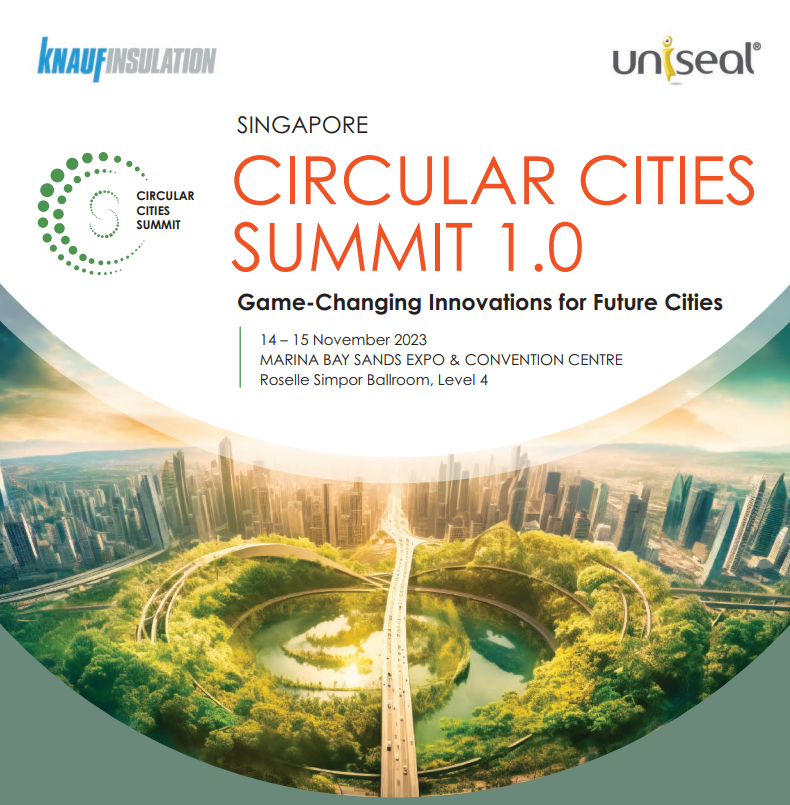
Join Dr. Manfred Koehler, President of WGIN, at the Circular Cities Summit 1.0 on 14 – 15 November 2023, aiming to facilitate a global conversation amongst leaders and practitioners on the circular economy and sustainable urban solutions, with a focus on innovative approaches and best practices.
14 – 15 November 2023
Sands Expo & Convention Centre
Singapore
Summit Programme:
DAY 1 — Conference
- 9:00 am – 6:00 pm | EARLY BIRD: SGD 200 (Limited to FIRST 200 Registrants only)
- Regular Price: SGD 300 | Business Package: SGD 450 (Conference + Cocktail)
- Exclusive C-Suites Networking Cocktail Night
6:00 pm – 9:00 pm | Fee: SGD 180
DAY 2 — Technical Tour
- 8:00 am – 12:30 pm | Fee: SGD 100
- Explore Singapore | ABS & ArchXpo 2023
12:30 pm – 6:00 pm
View the full summit programme here.
Call to Rethink
The inaugural Circular Cities Summit 1.0 themed “Game-Changing Innovations for Future Cities” would focus on exploring innovative solutions and strategies for achieving sustainability and circularity in the built environment. The pursuit of circular cities is seen as a crucial step towards achieving the United Nations’ Sustainable Development Goals, particularly Goal 11, which aims to make cities and human settlements inclusive, safe, resilient, and sustainable.
What is a Circular City?
A circular city is a city designed to function in a circular economy, which is an economic system aimed at minimizing waste and making the most of resources. In a circular city, resources are used and managed in a way that is sustainable and regenerative, and waste is minimized through reuse, recycling, and other forms of resource recovery.
Circular cities are designed with a focus on sustainability and resilience, and they typically incorporate elements such as green spaces, public transportation, renewable energy sources, and smart technology to optimize resource use and reduce waste. Circular city planning also takes into account the social and economic needs of the community, with a focus on creating a livable and equitable urban environment for all residents.
Summit Discussion Topics
- Circular design principles and strategies for buildings and landscapes
- Emerging technologies and innovative solutions for sustainable construction and maintenance
- Circular material use and resource efficiency in buildings and landscapes
- Sustainable building practices, including low carbon and energy-efficient design
- Circular economy approaches for managing waste and resources in the built environment
- Urban planning and design for circular cities and communities
- Case studies of successful circular and sustainable building and landscape projects
- Sustainable engineering approaches and more.
Speaker Highlights
- Dechen Tsering
REGIONAL DIRECTOR AND REPRESENTATIVE OF UNEP ASIA AND THE PACIFIC OFFICE - Guan Yisong
HEAD OF ELLEN MACARTHUR FOUNDATION, CHINA - Dr. Julian Kirchherr
PARTNER, MCKINSEY & COMPANY - Sasa Bozic
SOCIAL SUSTAINABILITY CONSULTANT, SOPHIA ACADEMY FOUNDER, AUTHOR - Dr. Manfred Koehler
PRESIDENT, WORLD GREEN INFRASTRUCTURE NETWORK (WGIN) - …and many more. View the full list of speakers here.
More about the summit
- The Summit aims to facilitate a global conversation amongst leaders and practitioners on the circular economy and sustainable urban solutions, with a focus on innovative approaches and best practices.
- Power-packed with keynote speeches, panel discussions, interactive sessions, innovation launches, exclusive display, networking opportunities and more.
- Excellent platform for participants to exchange ideas and collaborate on future initiatives.
- 800 – 1000 delegates expected with post streaming that will reach more than 30,000-50,000 audience worldwide via different media platforms.
More information: www.circularcitiessummit.com
Register here