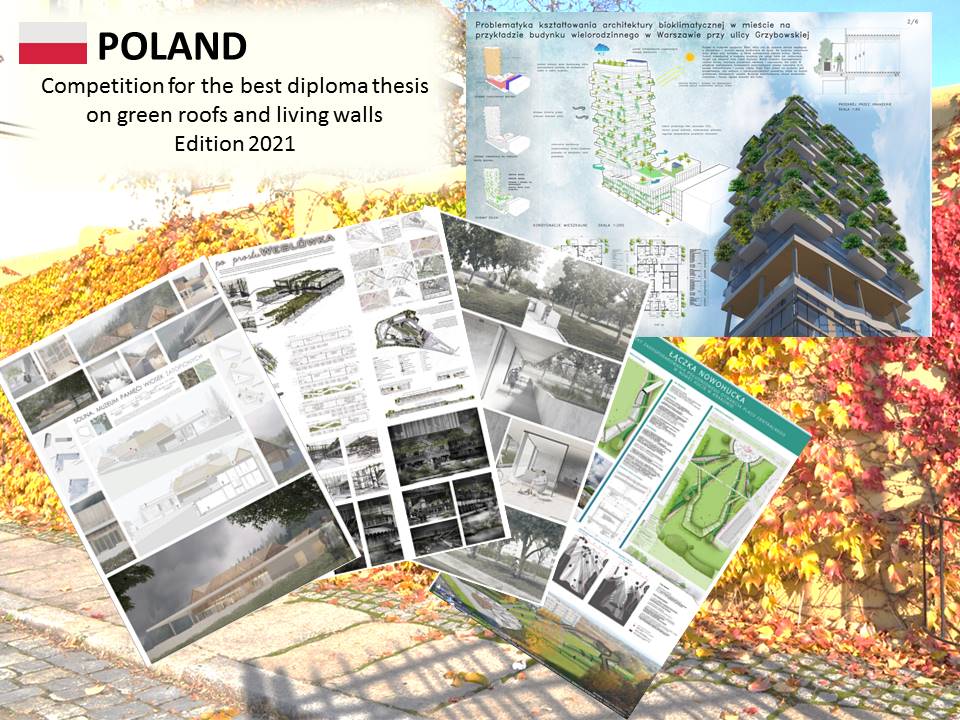
Competition for the best diploma thesis on green roofs and living walls

Competition for the best diploma thesis on green roofs and living walls

In the fall of 2020, PSDZ for the first time launched a competition for authors of master’s and engineering theses on green roofs and walls. Competition works were sent by the end of January 2021, and the results of the competition were announced in March.

Diploma theses for the competition were sent from 12 universities from all over Poland. The awards are of a financial nature and free annual membership in the Polish Green Roof Association. In addition, in the case of engineering diploma theses, the first prize was a 2-week internship at Optigrün in Germany; and for the second place – a 2-week internship at Optigrün in Poland.

Members of the jury awarded prizes for:

–        high substantive and graphic level

–        originality of the design idea

–        application of solutions limiting the influence of the building on the environment and local climate

In the category of master’s theses, the winners were:

1st place – Paula Karpowicz and Anna Karbowska from Cracow University of Technology, supervisor:  Barbara Zin, PhD

2nd place – Aleksandra Irzyk from Cracow University of Technology, supervisor: Tomasz Kapecki, PhD

3rd place – Magdalena Bieryło from University of Ecology and Management in Warsaw, supervisor: Janusz Marchwiński, PhD

 In the category of engineering diploma theses:

1st place – Łukasz Modrzejewski from Wroclaw University of Science and Technology, supervisor: Tomasz Głowacki, PhD

2nd place – Marcelina Smolarczyk from Cracow University of Technology, supervisor: Izabela Styka, PhD

3rd place – the jury did not award the third place
Follow us on our social channels.

Follow us on the channel that best suits you to receive our latest updates!

NEW

LATEST POSTS

Save the date: World Green Infrastructure Congress 2026

Join us at: World Green Infrastructure Congress BARCELONA 2026 October 27–29: CCIB – Parc del Fòrum, Barcelona (Spain) October 30: University of Lleida – Catalunya (Spain) Organized by: University of Lleida Co-organized by the World Green Infrastructure Network (WGIN). Visit WGIC26.Barcelona

WGIC26 – Closing the gap between communities of practice for green infrastructure and health

  WGIN’s mission statement is “The World Green Infrastructure Network advocates for optimal use of green infrastructure in the urban built environment for the health and well-being of people and the planet.” WGIN has in recent years acknowledged a gap in the attention we’ve given to the human health and well-being benefits of urban green infrastructure. The next World Green Infrastructure Congress, WGIC26, in Barcelona in October 2026 will address this gap by dedicating one of its three thematic tracks to health and well-being. Our congress hosts, the University of Lleida, expect this track will contribute to increased focus on health and well-being within our community of practice, and will hopefully contribute to increased interdisciplinary collaboration with the health sector. WGIN members and stakeholders are encouraged to support and help distribute the soon to be published call for papers for WGIC26 through their websites, social media and personal networks and to assist in recruiting the health community to join us in Barcelona. Through stronger interdisciplinary collaboration we can foster greater recognition and support for urban and building integrated green infrastructure and its relevance in health research, policies and practices. The socioeconomic system seen through the One Health lens. Source

Green Street Standards – A Breakthrough in Urban Green and Blue Infrastructure (Wrocław, Poland)

Local stormwater management in a rain garden collecting runoff from S. Drabika Street, Wrocław (Poland). (Photo: J. Rubaszek). Planning and designing green and blue infrastructure (GBI) as an integral part of urban streets – as is widely recognised – requires support in terms of organisation, funding, legislation and social awareness. As demonstrated by the case of Wrocław – one of the fastest-growing cities in Poland – standards can serve as an effective tool for supporting the implementation of GBI. These standards include guidelines and model solutions that integrate spatial, technical, and environmental aspects. Before establishing these standards, introducing green and blue infrastructure to Wrocław’s streets – even in newly planned projects – posed significant challenges. The main obstacles included insufficient space, the location of underground utility networks in areas that could otherwise accommodate trees, and relatively low public awareness of the importance of creating proper conditions for vegetation, especially large street trees. Read the full article here.