We have already been talking about the real performance of green roofs, in terms of improved energy efficiency, better storm-water management, lower heat-island effects and more – because it’s all about achieving good environment performance.
However, this time we look at the expectations of green roofs from the customer’s perspective.
There are certain local aspects and requirements that contribute to the fine-tuning of green roof design.
Let’s narrow these aspects down to 4 crucial elements:
• climate conditions where the green roof will be set-up
• type of building and type of roof where the green roof will be installed
• the future purpose of the new green space being installed
• local legal requirements
We will not go into any theoretical debates here, but rather focus on two borderline case stories, where customer needs particularly determined the type of green roof construction, and where employing a traditional green roof simply doesn’t work.
DUBAI, UAE
Let’s first start with the climatic conditions that green roofs need to survive under extreme heat and humidity. And when talking about extreme, we’re talking about summer daytime temperatures that can easily exceed 50º C / 120º F.
a roof on a four-storey building that connected two residential skyscrapers
recreational space where residents could meet and relax
There were a few main requirements on the investor’s side:
- The green roof needs to be lush, so that residents will see it as a real field of flowers and grasses
- The green roof should not be too heavy, as the area dedicated to installation of the green roof was a roof covering meeting rooms below
- The green roof can be irrigated, but should not require more irrigation water than what the Dubai code specifies for parks and gardens
Initially, this seemed too much of a challenge to overcome. Knauf Insulation had to design a green roof no larger nor greater than 60 kg/m2 (12 lbs/ft), that would not consume more than 8 litres/m2 (0.3”) of water per day in the highest summer months, and would continue to look lush and green.
Just look at what they were able to develop using only 6 cm (2.5”) of growing media, which weighed less than 50kg/m2 (10lbs/ft) fully saturated.
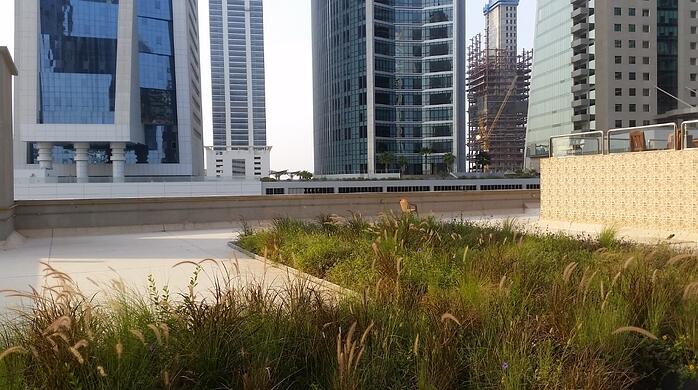
A roof on a four-storey building that connected two residential skyscrapers
recreational space where residents could meet and relax
RIGA, LATVIA
This other project was entirely different in terms of climate conditions. The project was executed in the Baltics – in Riga, Latvia – where winter temperatures can easily drop well below -20º C / -5º F.
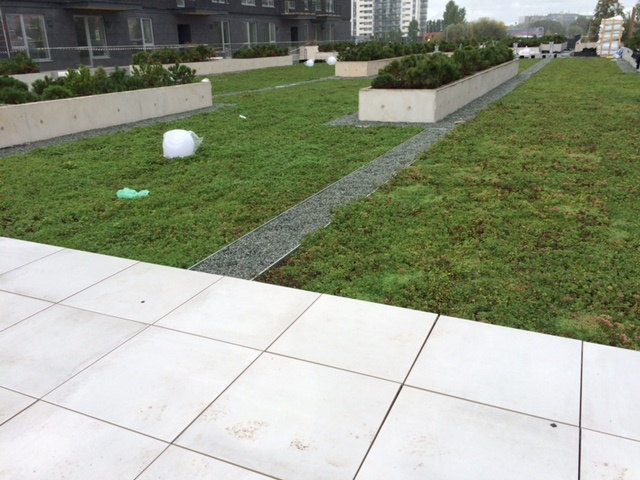
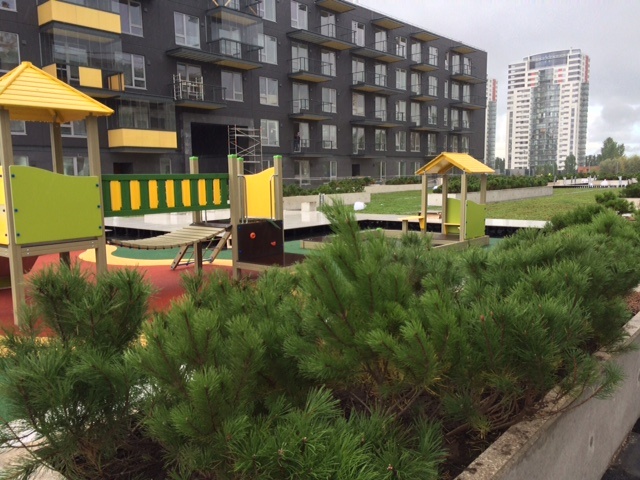
Like the Dubai case, the Riga green roof was built in a residential area. The roof between the residential buildings was meant to be a recreational space, where families could relax late in the afternoon and watch kids play in the rooftop-playground.
The simplest green roof structure using grass over the entire roof would have been the cheapest alternative; however, this would actually require a lot of maintenance over the years to come, which would be a burden for future residents, so this idea was initially scrapped.
The following requirements were drawn up for Knauf Insulation to follow:
• The green roof needs to be fully vegetated on the day the first residents arrive
• The green roof should remain nice, even in the colder winter months when not covered in snow
• The green roof should require a minimum of maintenance, meaning low additional costs for the residents
• The original design should make the roof thicker than the pathways made of concrete paving stones
• The green roof must act as a storm-water management tool.
The difficult part here was to provide sufficient storm-water management with a thin structure that would not exceed the height of the pavers. This cannot be done with regular green roof soil, so a structure that employed Urbanscape Growing Media, just 4 cm thick (1.8”) was used. This 4 cm thick structure could still hold the majority of the annual rainfall (more than 70%) that usually pours down on the roofs of Riga. Once built and ready, the entire place looked fantastic, and complied with all of the initial requirements.
We all know that Urban Green Infrastructure is truly the industry of the future and in order to support faster growth, we need to respect the needs and wishes of our potential users. Sometimes this means that the need to look outside the box and beyond traditional ways of doing business.