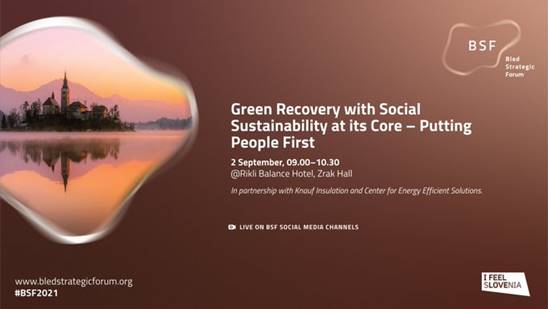
WGIN at Bled Strategic Forum 2021

WGIN at Bled Strategic Forum 2021

02 SEPTEMBER 2021

BACKGROUND

From year to year, we are facing stronger environmental changes. We are failing to meet the Paris 2°C target, sea levels are rising at an alarming rate, CO2 emissions remain at record levels. As more and more pressure arises to take action, we need to seek new, creative and bold solutions. What is the next step towards »Green Recovery«? Alongside environmental challenges, the past year has challenged humanity with the covid-19 pandemic. The pandemic brought rise to a variety of challenges, human wellbeing being one of them. From lock-down to lock-down, most of humanity saw the importance of social interactions affecting our society and individuals’ mental health. Yet from all of the challenges, human wellbeing remains the most understated. Have we foreseen the next step for »Human Recovery« as well?

We have long known that solving complex problems requires an interdisciplinary approach, that bringing people from various fields together can yield great results and that times of crises also give rise to new opportunities for change. The New European Bauhaus is a creative and interdisciplinary movement in the making, which is fast gaining momentum. It is a platform for experimentation, bringing together citizens, experts, businesses, and Institutions that want to design our future ways of living together. There are many correlations between mental health, wellbeing and nature. Looking at the future and the steps that we as leaders, companies and individuals must take, let’s ask ourselves if helping nature and driving »Green Recovery«, will also help us thrive as humans. Sustainability is not only about helping nature to heal, it is also about creating a thriving environment for humans in the long run.

How can we make the European Green Deal tangible? How do we ensure that changes are inclusive? Do the challenges which arose because of the COVID-19 pandemic also offer opportunities for a new approach? How can collaboration between sectors and industries boost the implementation of the Green Deal?

AGENDA

Dr Saša Bavec, Member of Executive Committee, Knauf Insulation Group

Ms Saša Božič, Founder and CEO, Sophia Academy

Mr Manfred Köhler, President, World Green Infrastructure

Ms Ruth Reichstein, The New European Bauhaus Initiative, Advisory Board to the President, European Commission

Mr David Thomson, Vice President, TFG Hotel Management Company

Ms Anja Zorko, Head, Center for Creativity, Museum of Architecture and Design

Ms Urška Zupanec, Head of Unit for the Slovenian Presidency of the EU Council 2021 program, Ministry of Education, Science and Sport of Slovenia

Moderated by Mr Gregor Benčina, President, Center for Energy Efficient Solutions (CER)

VIEW RECORDING

More information: https://bledstrategicforum.org/programme/
Follow us on our social channels.

Follow us on the channel that best suits you to receive our latest updates!

NEW

LATEST POSTS

Save the date: World Green Infrastructure Congress 2026

Join us at: World Green Infrastructure Congress BARCELONA 2026 October 27–29: CCIB – Parc del Fòrum, Barcelona (Spain) October 30: University of Lleida – Catalunya (Spain) Organized by: University of Lleida Co-organized by the World Green Infrastructure Network (WGIN). Visit WGIC26.Barcelona

WGIC26 – Closing the gap between communities of practice for green infrastructure and health

  WGIN’s mission statement is “The World Green Infrastructure Network advocates for optimal use of green infrastructure in the urban built environment for the health and well-being of people and the planet.” WGIN has in recent years acknowledged a gap in the attention we’ve given to the human health and well-being benefits of urban green infrastructure. The next World Green Infrastructure Congress, WGIC26, in Barcelona in October 2026 will address this gap by dedicating one of its three thematic tracks to health and well-being. Our congress hosts, the University of Lleida, expect this track will contribute to increased focus on health and well-being within our community of practice, and will hopefully contribute to increased interdisciplinary collaboration with the health sector. WGIN members and stakeholders are encouraged to support and help distribute the soon to be published call for papers for WGIC26 through their websites, social media and personal networks and to assist in recruiting the health community to join us in Barcelona. Through stronger interdisciplinary collaboration we can foster greater recognition and support for urban and building integrated green infrastructure and its relevance in health research, policies and practices. The socioeconomic system seen through the One Health lens. Source

Green Street Standards – A Breakthrough in Urban Green and Blue Infrastructure (Wrocław, Poland)

Local stormwater management in a rain garden collecting runoff from S. Drabika Street, Wrocław (Poland). (Photo: J. Rubaszek). Planning and designing green and blue infrastructure (GBI) as an integral part of urban streets – as is widely recognised – requires support in terms of organisation, funding, legislation and social awareness. As demonstrated by the case of Wrocław – one of the fastest-growing cities in Poland – standards can serve as an effective tool for supporting the implementation of GBI. These standards include guidelines and model solutions that integrate spatial, technical, and environmental aspects. Before establishing these standards, introducing green and blue infrastructure to Wrocław’s streets – even in newly planned projects – posed significant challenges. The main obstacles included insufficient space, the location of underground utility networks in areas that could otherwise accommodate trees, and relatively low public awareness of the importance of creating proper conditions for vegetation, especially large street trees. Read the full article here.