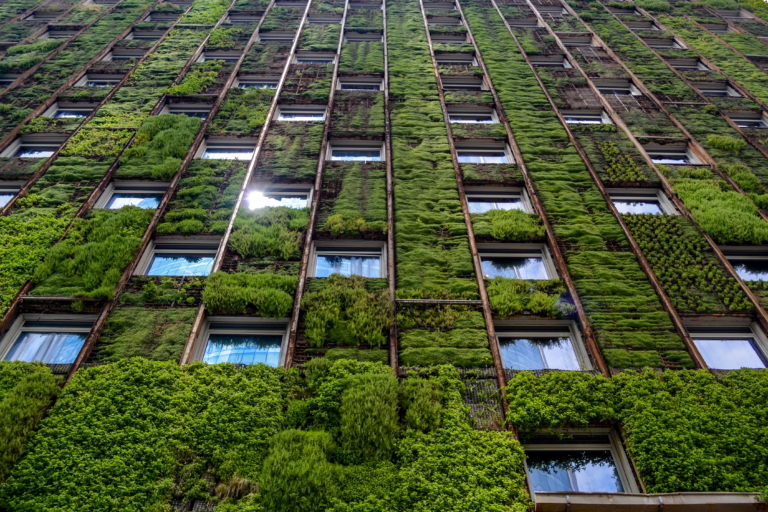
Wall of high-rise building covered with plants, reflection of sunlight in one of the windows. Shutterstock ID: 1251913315
Now in its fourth Year, International Green Wall Day on 15 February celebrates and highlights the beauty and environmental benefits of living walls.
The date marks the 133 year anniversary of the birth of the living wall inventor and visionary landscape architect Stanley Hart White.
On this day the major architects, designers, manufacturers and installers of living walls come together across social media channels, to share their best work with videos, images and articles, using the hashtag #GreenWallDay. This creates a useful snapshot of the current global state of play for green walls. Everyone is invited. It is free.
Despite the first patent being filed for a living wall in 1938, they did not become mainstream until the millennium. Since then, green walls have grown in popularity all over the world, becoming ever bigger and more spectacular.
“It is a common misconception that the living wall is a modern invention. But it was invented over 80 years ago. Imagine how different our cities would look today if architects, developers, planners and governments had made Stanley Hart White’s living walls core to urban development for the past 80 years. Would we still be threatened with such a severe climate catastrophe if, for eight decades, we had built our cities green instead of grey?” James Beattie, Chief Operating Officer of Pritchard & Pritchard and founder of #GreenWallDay.
To take part use the hashtag #GreenWallDay on all social media to share your living wall images, videos and thought-leadership articles. Join the Green Wall Day party on: Linkedin; Instagram; Twitter/X and Facebook.
The current world record holders (unofficial… the Guiness Book of Records is years out of date!) are:
- Largest indoor living wall project is Kempegowda International Airport T2, India, with over 10,235sqm of green walls, featuring 450,000 plants.
- Largest outdoor living wall is Khalifa Avenue, Qatar, with a total area of 7,000sqm.
- Tallest indoor living wall is Menara Hap Seng 3, Malaysia, at 91m.
- Tallest outdoor living wall is in Medellín, Colombia at 92m.
The Green Wall Day video features the most spectacular living walls from around the World.
Living walls or green walls are created by fixing a framework of troughs, pockets or mats to an indoor or outdoor wall or fence into which a multitude of smaller plants are planted. These plants are maintained by an irrigation system.
Benefits of living walls to the environment and to buildings include:
- Improving biodiversity by providing breeding, nesting and food source for birds and invertebrates.
- Helping to trap dust, particulates and other pollutants from both the air and rainfall on the leaves of plants.
- Providing winter insulation for buildings reducing demand for heating by up to 25 per cent.
- Providing shading from the sun, living walls can reduce temperature fluctuations of walls by up to 50%, helping to reduce Urban Heat Island effect (UHIE).
- Shielding buildings from ultra-violet light and rain, which can damage walls.
- Source: Living Roofs and Walls Technical Report: Supporting London Plan Policy.
To contact Pritchard & Pritchard or reach out to any of the supporters of #GreenWallDay, email info@pritchardandpritchard.com