
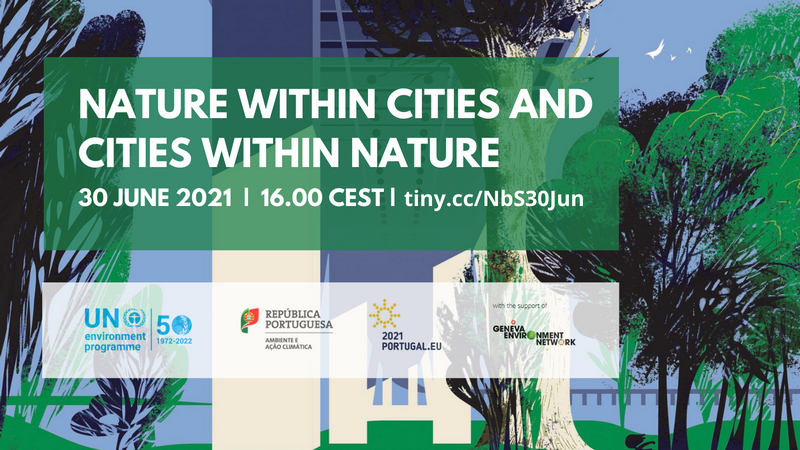
Nature within cities and cities within nature

Nature within cities and cities within nature

30 JUNE 2021

BACKGROUND

You are cordially invited to a high-level event, co-organized by the United Nations Environment Programme and the Portuguese EU Presidency, aiming at demonstrate the value of Nature-based Solutions (NbS) for cities, from developing climate resilient pathways to harnessing a broad range of environmental and socio-economic benefits. The event will highlight local participatory approaches as bases for long-term success, look at ways to scale impact with innovative approaches and call for genuine action across differentscales and sectors.

The event will focus on exploring the multiple benefits of NbS for cities, highlighting opportunities and challenges to advance and scale up NbS, from local action to global solutions, accelerating impact in 2021 and beyond. The event starts with a high-level panel (16:00 – 16:30 CEST) which will discuss how the application of NbS can provide long-term social, ecological and economic benefits. The second session (16:30 – 17:30 CEST) features two technical panels with a focus on implementation challenges and opportunities as well as models for scaling up NbS from local action to global solutions.

AGENDA

Opening Remarks H.E. João Pedro MATOS FERNANDES, Portuguese Minister for the Environment Inger ANDERSEN, Executive Director, UNEP Multiple Benefits of NbS H.E. Ana ABRUNHOSA, Portuguese Minister of Territorial Cohesion H.E. Svenja SCHLUZE, German Federal Minister for the Environment, Nature Conservation and Nuclear Safety (Video) H.E. Andrej VIZJAK, Slovenian Minister of the Environment and Spatial Planning (Video) Opportunities and Challenges to Advance NbS Philippe TULKENS, acting Head of Unit, DG Research & Innovation, Healthy Planet Directorate, European Commission Ana DAAM, Head of Division of Sustainable Finance and Adaptation, Portuguese Environment Agency Rosário OLIVEIRA, Researcher, Institute of Social Sciences (ICS), University of Lisbon From Local Action to Global Solutions: Models for Scaling up NbS Duarte D´ARAÚJO, Landscape Architect, Lisbon Municipality Angela CRUZ GUIRAO, Director of Green and Sustainable Development, Campinas City Hall Q&A session Wrap up by Moderators Susana NETO (University of Lisbon) and Catarina ROSETA-PALMA (ISCTE-IUL)
Follow us on our social channels.

Follow us on the channel that best suits you to receive our latest updates!

NEW

LATEST POSTS

Save the date: World Green Infrastructure Congress 2026

Join us at: World Green Infrastructure Congress BARCELONA 2026 October 27–29: CCIB – Parc del Fòrum, Barcelona (Spain) October 30: University of Lleida – Catalunya (Spain) Organized by: University of Lleida Co-organized by the World Green Infrastructure Network (WGIN). Visit WGIC26.Barcelona

WGIC26 – Closing the gap between communities of practice for green infrastructure and health

  WGIN’s mission statement is “The World Green Infrastructure Network advocates for optimal use of green infrastructure in the urban built environment for the health and well-being of people and the planet.” WGIN has in recent years acknowledged a gap in the attention we’ve given to the human health and well-being benefits of urban green infrastructure. The next World Green Infrastructure Congress, WGIC26, in Barcelona in October 2026 will address this gap by dedicating one of its three thematic tracks to health and well-being. Our congress hosts, the University of Lleida, expect this track will contribute to increased focus on health and well-being within our community of practice, and will hopefully contribute to increased interdisciplinary collaboration with the health sector. WGIN members and stakeholders are encouraged to support and help distribute the soon to be published call for papers for WGIC26 through their websites, social media and personal networks and to assist in recruiting the health community to join us in Barcelona. Through stronger interdisciplinary collaboration we can foster greater recognition and support for urban and building integrated green infrastructure and its relevance in health research, policies and practices. The socioeconomic system seen through the One Health lens. Source

Green Street Standards – A Breakthrough in Urban Green and Blue Infrastructure (Wrocław, Poland)

Local stormwater management in a rain garden collecting runoff from S. Drabika Street, Wrocław (Poland). (Photo: J. Rubaszek). Planning and designing green and blue infrastructure (GBI) as an integral part of urban streets – as is widely recognised – requires support in terms of organisation, funding, legislation and social awareness. As demonstrated by the case of Wrocław – one of the fastest-growing cities in Poland – standards can serve as an effective tool for supporting the implementation of GBI. These standards include guidelines and model solutions that integrate spatial, technical, and environmental aspects. Before establishing these standards, introducing green and blue infrastructure to Wrocław’s streets – even in newly planned projects – posed significant challenges. The main obstacles included insufficient space, the location of underground utility networks in areas that could otherwise accommodate trees, and relatively low public awareness of the importance of creating proper conditions for vegetation, especially large street trees. Read the full article here.