Dr. Ali Al Jassim is a distinguished leader in sustainability and green building innovation, widely recognized for his pioneering role in advancing sustainable development across the Middle East and internationally.
As Founder and Chairman of the Society of Sustainability & Green Materials (SSGM), Dr. Al Jassim has established a platform that unifies corporate, academic, and individual stakeholders to accelerate the adoption of sustainable practices and green materials in the UAE and beyond. His vision is rooted in the belief that sustainability must be embedded into every aspect of urban development, from materials and supply chains to governance and community engagement.
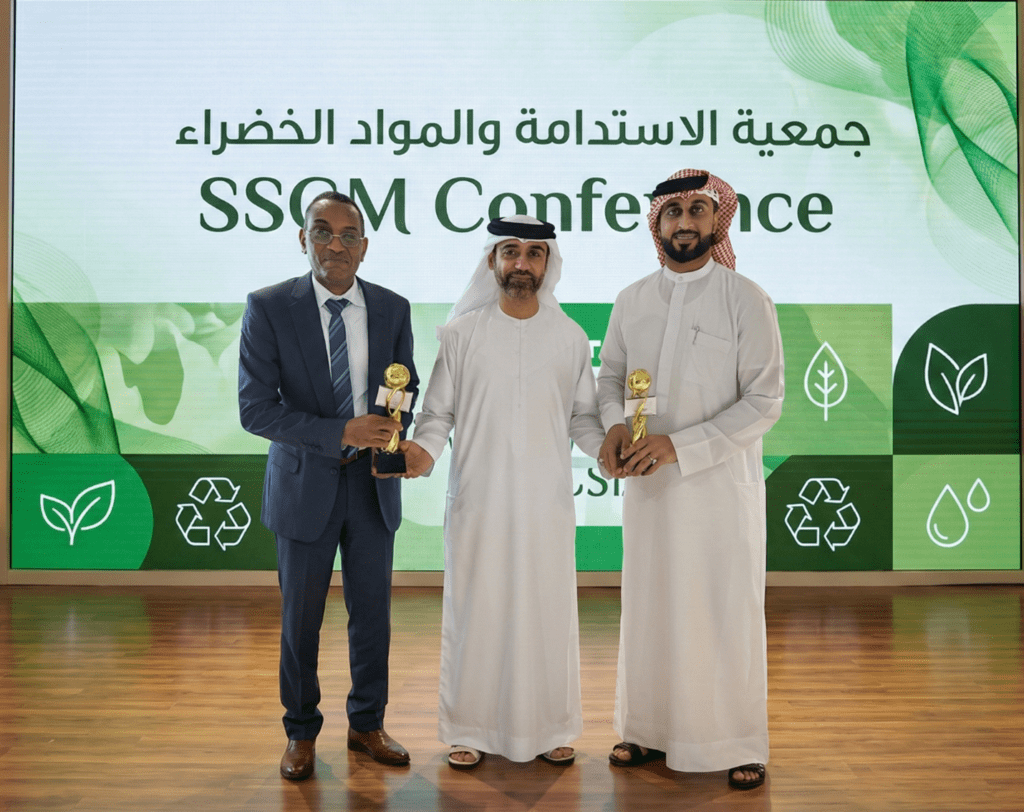
Mr. Musaed Mohamed Alblooshi – Inspector, Monitoring and Inspection Department, Regulatory and Licensing Sector, The Community Development Authority in Dubai along with Dr. Ali Al Jassim, Founder and Chairman of SSGM & Dr. Waleed Yagoub, Co-Founder and Treasurer of SSGM
SSGM, launched in 2022 under the Community Development Authority (CDA) in Dubai, is a non-profit membership-driven organization dedicated to promoting sustainability and reducing CO₂ emissions. The Society provides technical guidance, free publications, training workshops, and direct collaboration with authorities to develop regulations that support sustainable growth. Its mission is to create a comprehensive database of green materials and foster awareness through education, engagement, and partnerships.
Under Dr. Al Jassim’s leadership, SSGM has become a hub for innovation in sustainability. The Society offers a Green Materials Database and Library, enabling organizations to benchmark their products and services against international standards. Through its GSES Dashboard and Scorecards, members can measure, verify, and improve their sustainability performance, aligning with global frameworks such as the ISO 14064-1, ISO 50001, and the Greenhouse Gas Protocol. Corporate members benefit from independent audits, consultancy tools, and access to procurement modules that integrate sustainability into supply chains. Individual and student members gain opportunities to participate in workshops, webinars, and knowledge-sharing activities, ensuring that the next generation of professionals is equipped to lead the sustainability transition.
Dr. Al Jassim’s influence extends beyond SSGM. He was the Chairman of the Emirates Green Building Council and has served as Vice Chair of the World Green Building Council’s MENA Regional Network, where he has championed net-zero strategies and sustainable urban development. His leadership in initiatives such as the Circular Cities Summit 2.0 in Dubai highlights his commitment to integrating circular economy principles into urban planning, addressing pressing challenges such as climate change, air pollution, and resource efficiency.
Through SSGM, Dr. Al Jassim has created a collaborative ecosystem that bridges government, academia, and industry. The Society’s activities—ranging from sustainability assessments to supply chain dashboards—reflect a holistic approach to environmental responsibility. By fostering partnerships and providing practical tools, SSGM ensures that organizations and individuals can contribute meaningfully to the UAE’s sustainability ambitions while gaining international recognition for their efforts.
Dr. Ali Al Jassim’s work embodies the mission of the World Green Infrastructure Network: to advocate for sustainable, resilient, and inclusive urban environments. His leadership at SSGM demonstrates how green materials and infrastructure can serve as catalysts for achieving global sustainability goals, making him and his organization valuable partners in advancing the shared vision of greener cities worldwide.
For the World Green Infrastructure Network, with its vision, “Nature in cities for people and planet”, SSGM’s application of sustainability metrics offers an important and necessary pathway toward sustainability and greening of green infrastructure.
As a member of the World Green Infrastructure Network, Dr. Al Jassim and SSGM are particularly interested in networking and collaboration around the challenges and opportunities related to:
- Advancing circular economic principles in urban planning and development projects.
- Developing supportive policies and regulations in partnership with government and regulatory authorities.
- Accelerating the adoption of green materials through comprehensive databases and benchmarking standards.
- Achieving carbon neutrality and reducing emissions in alignment with global frameworks such as ISO standards and the Greenhouse Gas Protocol.
- Integrating sustainability into supply chains via procurement tools and performance dashboards.
- Empowering future professionals through specialized training programs, workshops, and knowledge-sharing initiatives.
- Advancing green infrastructure innovation through integrated partnerships across public, private, and academic spheres.
- Organizing and participating in global events focused on sustainable and resilient cities.
Inquiries to Dr. Al Jassim and SSGM may be addressed to:
Email: aljassim0@gmail.com
Phone: +971558000021